October 13, 2026
Enhancing bass has been an elusive pursuit for those making audio tools for decades.
In the eighties, there were hardware maximisers, and in the two-thousands, pitch-tracked bass generators; since then, a new wave of subharmonic tools has emerged.
We missed a subharmonic generator that sounds natural, almost barely noticeable from the start, with easy access to great weight and low end, with enough options for highly controllable dynamics and aggressive and creative over-the-top processing in the Boom style if needed.
According to Axel Rohrbach, our man in charge of developing UBERBASS, the technique adds harmonic content to the original material’s low-frequency audio signal, which results in new audio that stays very close to the original input; it sounds very natural. Of course, you can also take it to extremes if you want. After all, it’s not called UBERBASS for nothing!
How The Boost Actually Works
Axel explains that the added sound is more closely connected to the input than mere noise; it doesn't produce synthesised material, but instead adds overtone structure.
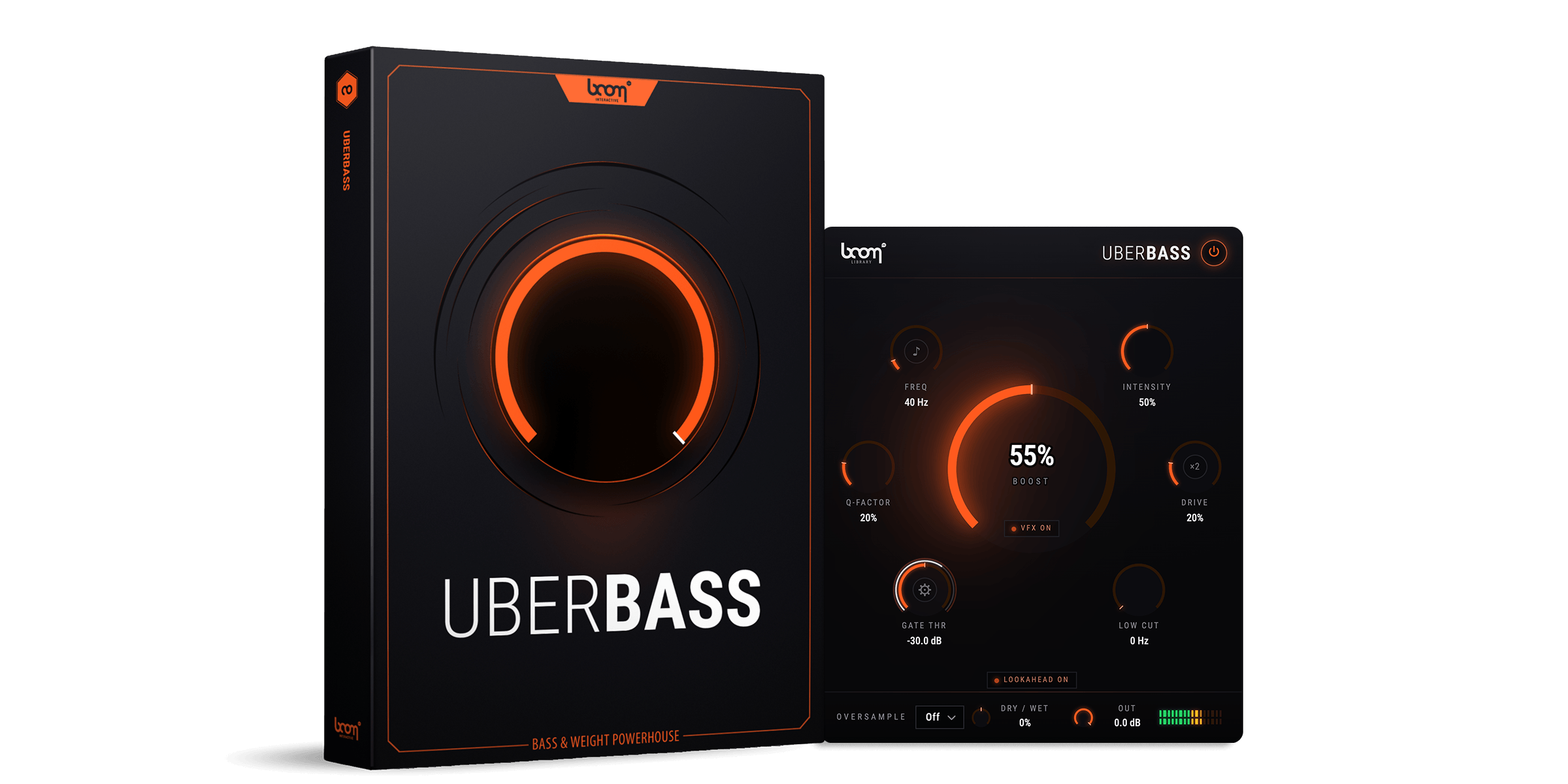
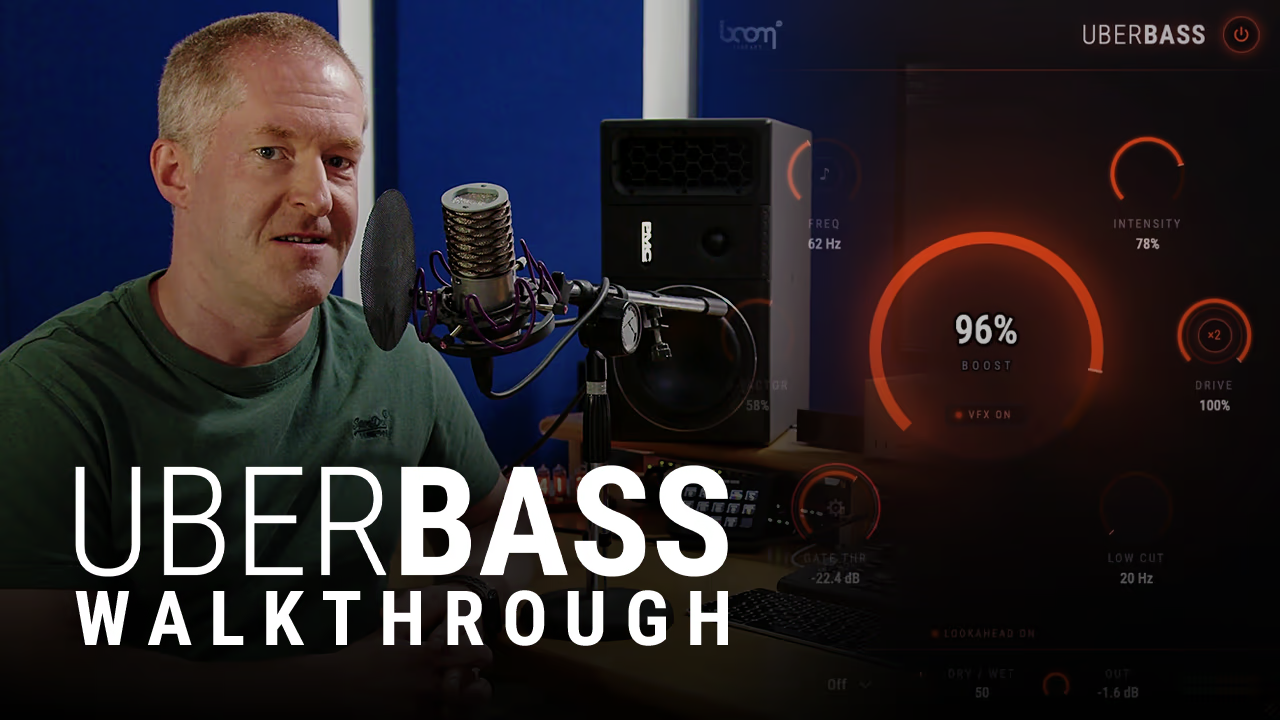
In practice, you can set FREQ to the subsonic or low-end part of your source, either in Hertz or by tuning it to a musical note. The Q-FACTOR determines how tightly the effect is concentrated around that frequency; it can be narrow and precise or spread over a broader band. Rather than simply amplifying what's already there, it synthesizes focused low-end and harmonics around the target frequency - so even a thin, bass-light signal can be given serious weight and impact. Stronger character comes from DRIVE: a dedicated saturation stage that introduces harmonic content, with a ×2 setting for when clean saturation still isn't strong enough.
When You Turn It Off
UBERBASS was initially developed by sound designers, but as we expanded the test group to industry professionals, it proved just as effective in music mixing, post-production, and live sound.
Ashton Parsons, front-of-house and monitor engineer for both Cage The Elephant and Disturbed, came at it from the other side of the desk: "UBERBASS has just replaced my go-to sub-harmonic for the last ten years. The minute you load the plugin onto your desired track, you can quickly hear the difference. From clean subharmonics to destroyed, you'll get the desired effect in no time: 10/10."
Joseph Fraioli, whose sound design and music credits include Tenet and Fallout, has spent a career with this category of tool: "I've spent years working with subharmonic synthesizers and low-frequency enhancers, and UBERBASS is my new go-to. Super clean, quick, and creative."
Producer and mixer Andy Bradfield (Moulin Rouge, Rufus Wainwright, WONKA!) found it pulling weight out of material he'd written off: "UBERBASS is a great plug-in and incredibly useful for enhancing the low end. It even enhances sources I thought had no low end! Best of all, it doesn't add any mud to the low end. It's very easy to dial in something huge that works quickly."
For music producer and composer Zacharias Adrian, it has become part of how he builds drums: "UBERBASS is basically my new shortcut to anything that needs more oomph. It quickly became my go-to whenever I want to add more tuned weight and punch to a kick that's already tuned to the key of the track, or even bring more impact to the entire drum bus."
Sound designer and effects recordist Robert Dudzic (Bad Boys: Ride or Die, The Tattooist of Auschwitz, GTA IV) started by running his own field recordings through it: "I simply played a couple of samples from my junkyard recordings through it, and wow."
What stayed with him was how little it took. "UBERBASS is about adding weight and body without taking away what makes the original recording feel authentic. Even with a very gentle touch, it can make a huge difference, bringing out those missing low frequencies and giving the sound more depth, thickness, and physical presence. A simple closing door can suddenly become a powerful cinematic impact, while still sounding completely natural and not overproduced." says Robert.
He also puts into words what BOOM's own team ran into when they bypassed it. "That's what I really like about UBERBASS . It doesn't feel like you're forcing the sound to become bigger. It simply gives it the weight that feels like it should have been there from the beginning. For me, adding low-end isn't just about making a sound bigger or louder. It's about making the audience feel the sound, not just hear it."
The Uberbass Difference
The gate prevents the effect from entering quieter sections of the signal, so the drum kit is boosted on the beats without a continuous rumble. It uses a full envelope, not just a threshold, including attack, release, and ratio, and two rings on the knob display the incoming level and the amount of gain reduction in real time.
Axel explains that the gate dictates when the effect kicks in and how much, relative to the input signal's loudness. Instead of sending out subharmonics all the time, you can use it to trigger only during louder sections. If you want, it cuts off the rumbling in tails, reverbs, or generally quieter parts, and the result is a tighter sound.
The low-cut setting removes unwanted rumble from the processed signal. The dry/wet control balances the treated signal against the original one. Oversampling is included in case DRIVE and BOOST are pushed hard, and aliasing begins to appear.
UBERBASS reinforces what's already in the signal. The subharmonics it generates lock onto the source, so the added weight sounds like part of the original recording. That's UBERBASS in a nutshell. It's also probably why so many people switch it on and forget it's there.
It works higher up the spectrum too. Plenty of material doesn't need more sub. It needs more body. UBERBASS is just as effective in the low mids, adding weight to sounds that feel thin without pushing energy into subwoofer territory.
Check it out today with a free, fully working trial version.
Software / Plug‑In
Uberbass
Bass Enhancer Plugin
Bass enhancer plug-in for music, sound design and sound for picture. Harmonically BOOST low end, focus it where the source needs it, drive it, gate it. Hear UBERBASS.